
Blog
Full Stack Developer: What You Get and When to Hire One
What a full stack developer does for your business, layer by layer, when one senior dev beats an agency, and the right questions to ask before you hire one.
Muhammad Zubair Akhtar
Most pages about the full stack developer role are written for people who want to become one. They list languages, a salary range and a learning path. If you run a business and you are deciding whether to hire full stack developer help, that list does not answer your real questions: what will this person actually build, what will I own at the end, and is one developer enough?
I am Zubair Akhtar, a senior software engineer in Lahore. My work runs from the database to the screen: Laravel and PHP back ends, React, Vue and Next.js front ends, WordPress, APIs, CRM and payment integrations, and the servers it all runs on. This is the buyer's version of the job description. It covers what you get at each layer, when one senior developer is the right call and when it is not, and how to check a candidate before you sign. That includes me.
The short answer
A full stack developer takes a feature from idea to production on their own. They build the screen a customer uses, the business rules behind it, the database it writes to, the integrations it calls, and the deploy that puts it live. The value for a business is not that one person knows many languages. It is that nobody has to hand the feature to someone else halfway through, so fewer details get lost.
The limit is just as simple. One person can only build one thing at a time, and nobody is equally deep everywhere. A good full stack developer will tell you which layer they are strongest in and when the work needs a specialist.
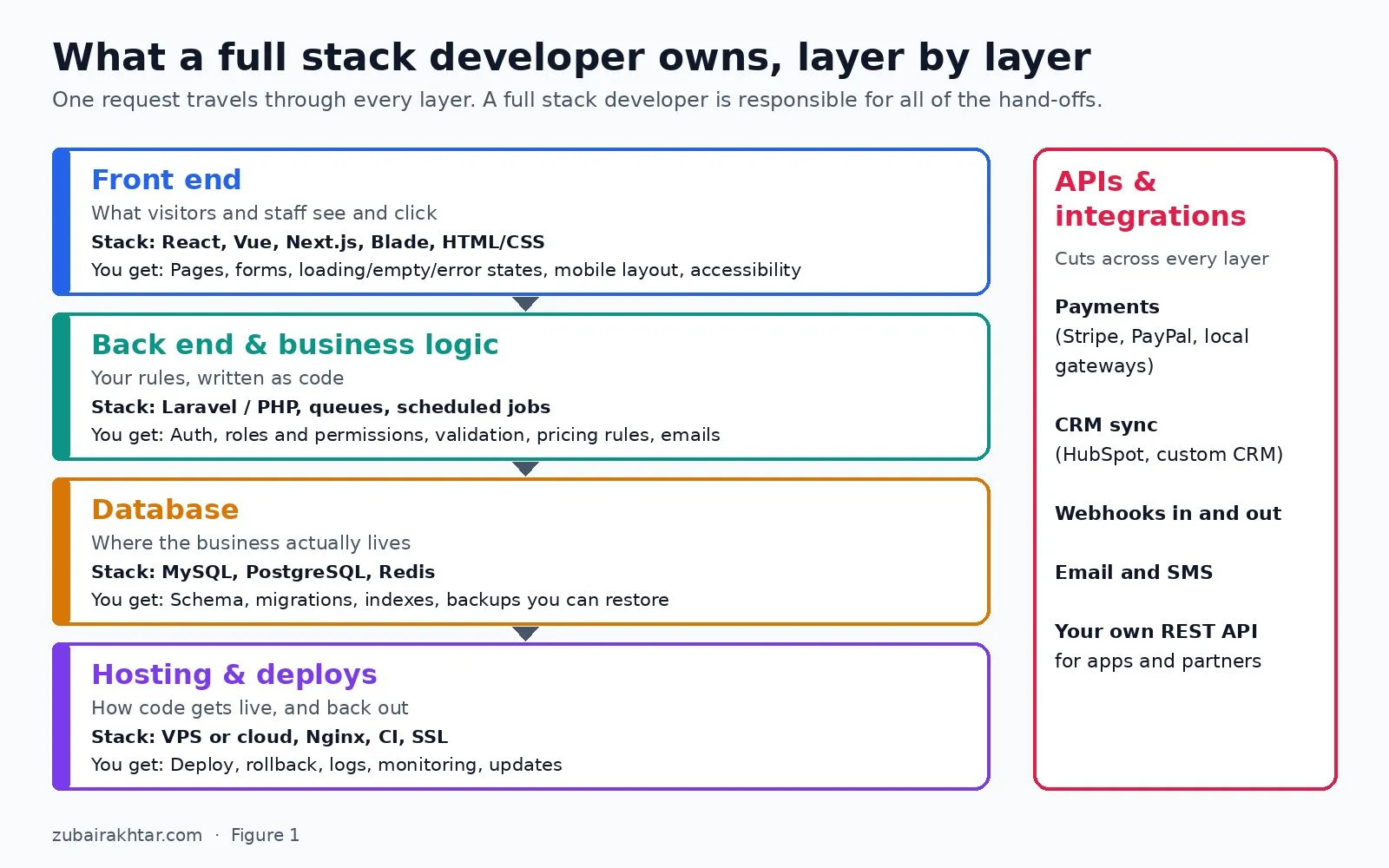
Figure 1. The layers a full stack developer owns, and what you should get from each.
What a full stack developer does, layer by layer
Here is what "full stack" should mean in deliverables, not job-ad keywords.
Front end: the part your customers judge you on
This is every page, form and dashboard people see. In my stack that is React, Vue or Next.js for app-like interfaces, and Blade templates or WordPress themes for content-led sites. What you should actually get:
- Layouts that work on a phone first, because that is where many visitors arrive.
- Forms that show clear errors next to the field, not a generic "something went wrong".
- Loading, empty and error states for every screen that waits on data. These are the screens people forget to design and customers always see.
- Accessible markup: real buttons, labels on inputs, keyboard navigation, readable contrast.
- Pages that load fast enough not to hurt sales or search. I covered the practical fixes in how to improve website speed.
Back end: your business rules, written as code
The back end decides who can do what, what a price is, what happens when an order is placed and which emails go out. I build this in Laravel. For a business owner, the deliverables are:
- Authentication and permissions checked on the server. Hiding a button in the interface is not security. The API has to refuse the request too.
- Validation on every input, so bad data never reaches the database.
- Background jobs for slow work such as invoices, imports, emails and syncs, so a customer is not left staring at a spinner.
- Logs that make sense, so when something fails at 2 AM there is a record of what happened.
Database: where the business actually lives
Code can be rewritten. Data is much harder to rebuild. A full stack developer designs the tables (MySQL or PostgreSQL in my case), changes them through versioned migrations rather than by hand, adds indexes where pages slow down, and sets up backups. The test that matters is simple: has anyone restored a backup? A backup nobody has restored is a hope, not a plan.
APIs and integrations: the parts that touch money and customers
Most business software is glue as much as it is screens: payments, a CRM, email or SMS providers, shipping, accounting. This is where full stack work tends to fail quietly, because a payment can succeed at the gateway while your database never hears about it. You want someone who designs for that: signature-checked webhooks, retries, and records that can be reconciled. If you are planning payments, read my payment gateway integration checklist. For how systems notify each other, see webhooks explained.
Hosting, deploys and the week after launch
"Full stack" includes getting code live and getting it back out when a release goes wrong. Ask how a change reaches production, how long a rollback takes, where errors are reported, and who renews the SSL certificate and applies security updates. For a Laravel app, my usual route is a VPS with Nginx, and I wrote up the steps in how to deploy Laravel to a VPS.
One feature, end to end: what a full stack web application looks like in practice
Abstract layers are easier to judge with a concrete feature. Take a common one, a "request a quote" form on a service business's site, and follow it through the stack. This is an illustration, not a client story:
- The front end shows a form that works on a phone, validates the email as you type, and shows a clear confirmation.
- The back end validates again on the server, blocks spam, and applies your rules, for example routing large jobs to a senior salesperson.
- The database stores the request with a status, so nothing lives only in someone's inbox.
- A background job emails the customer, notifies your team and pushes the lead into your CRM.
- An admin screen lets your staff see, assign and update requests, with permissions so a junior user cannot delete records.
- The deploy ships all of it together, with a way back if the CRM sync misbehaves.
With separate front-end and back-end contractors, steps 1 and 2 become a negotiation about who validates what. With one full stack developer, the same person owns both sides of every hand-off. That is the real advantage, and it is why the role suits small and mid-sized products so well.
One senior full stack developer, or a team?
This is where most hiring decisions go wrong in both directions. Businesses hire an agency for work one experienced person could do, or they hire one person for a scope that needs four. Figure 2 is the quick test I would use.
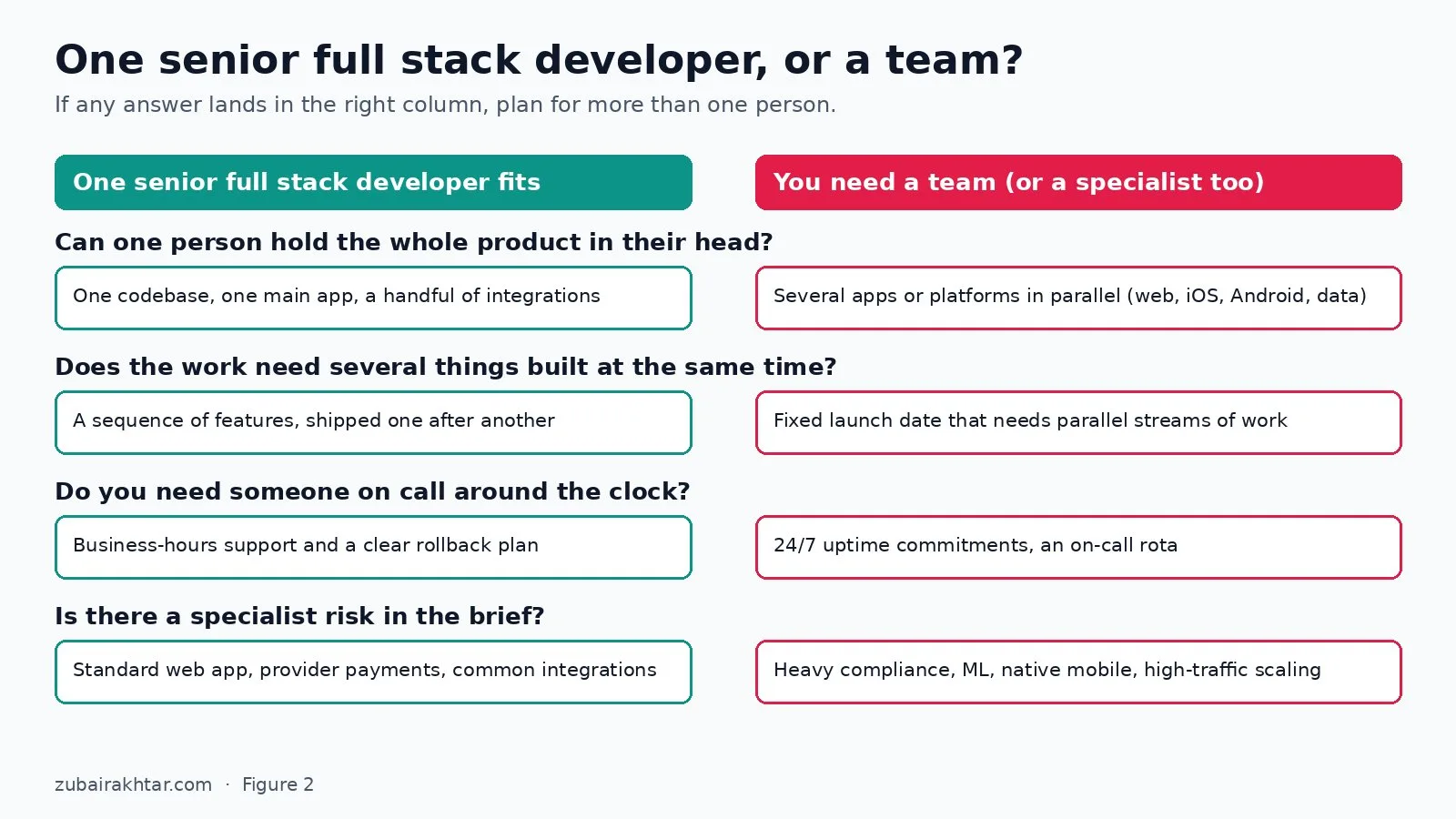
Figure 2. Four questions to decide between one senior full stack developer and a team.
When one senior developer beats an agency
- You have one main product: a web app, a portal, a store with custom logic, or an internal tool.
- Features can ship one after another instead of all at once.
- You want to talk to the person writing the code, not an account manager who passes messages on.
- You care about continuity. The person who built the billing logic is still there when it needs changing six months later.
- The integrations are standard: a payment provider, a CRM, email and an accounting tool.
When you genuinely need a team
- Several platforms have to move at the same time, such as web plus native iOS and Android apps.
- A fixed launch date needs parallel work that one person cannot do in the time.
- You need 24/7 on-call cover. One person cannot be a rota.
- The brief carries specialist risk: heavy regulatory compliance, machine learning, or traffic that needs dedicated infrastructure work.
There is a middle path that often works best: one senior full stack developer who owns the architecture, with a specialist brought in for a defined piece such as a brand designer, a native mobile developer or a security review. The full stack developer keeps the whole picture together.
What full stack development services should include
Whether you hire a freelancer, a contractor or an agency, these should be in the scope in writing. If something is missing, ask before you sign, not after launch.
- Discovery: a short written spec of features, user roles and integrations, agreed before the build starts.
- Your code, in your repository: a Git repository under your organisation's account, not the developer's personal one.
- Your accounts: hosting, domain, payment gateway and email provider registered to your business, with the developer added as a user.
- Environments: a staging site where you can review work before it reaches real customers.
- Tests on the parts that touch money, permissions and data.
- Secrets out of the code: API keys live in environment config, never committed to the repository.
- Deploy and rollback steps written down, so another developer could take over.
- Backups and monitoring set up, with a restore done at least once.
- Handover notes: how to run the project locally, where things live and which third-party services it depends on.
- Post-launch support: what is covered after go-live, for how long, and what counts as new work.
How to hire a full stack developer: questions to ask
You do not need to be technical to run a good interview. You need questions where a vague answer is easy to spot. These are the ones I would ask, and expect to be asked.
- "Walk me through one feature you built, from the database to the screen." A good answer names the table, the API endpoint, the permission check and the page, without slides.
- "Which layer are you weakest in?" Everyone has one. "None" is the wrong answer.
- "How does a change get to production, and how do you undo it if it breaks?" Listen for staging, a repeatable deploy and a rollback that takes minutes, not a weekend.
- "Where do you check whether a user is allowed to do something?" The answer must include the server, not only the interface.
- "How do you keep API keys and passwords out of the code?"
- "A page has become slow. How do you find out whether it is the browser, the server or the database?"
- "What would you hand to a specialist rather than do yourself?" Knowing their limits is a senior trait.
- "What happens after launch, and who do I call when something breaks?"
Then, instead of a whiteboard puzzle, pay for a small real task in a repository you own, touching both the interface and the back end. A short paid trial tells you more than any portfolio grid. If the stack is Laravel, my Laravel developer hiring checklist goes deeper into what to read in their code.
Red flags when you hire a full stack developer
- They claim expert level in everything. Breadth is the job, and depth is still finite.
- The code stays on their account until the final invoice is paid. Your repository should be yours from day one.
- No staging site. You will be reviewing changes on your live site with real customers.
- "We'll add security later." Permissions and validation are part of the feature, not a later phase.
- No answer on rollback. If they cannot explain how to undo a bad deploy, they have not had to yet, or they did it by hand.
- A price with no scope behind it. A number without the hours, revisions, testing and post-launch support it covers cannot be compared.
- The person on the sales call is not the person writing the code, and nobody will tell you who is.
Where my stack fits, and choosing the platform
A full stack developer is only as useful as the fit between their stack and your problem. I build custom applications, portals, APIs and CRM-style systems in Laravel, with React, Vue or Next.js on the front end where the interface needs it. That work sits under my Laravel development services.
Not every business needs a custom application. If most of your site is content, pages and a blog, WordPress is often the better and cheaper choice. I compare the two honestly in Laravel vs WordPress. Online stores have their own trade-offs, and I keep that work under ecommerce development.
FAQ
What is the difference between a full stack developer and a web developer?
"Web developer" is a broad label that can mean front end only, back end only, or a WordPress site builder. A full stack developer specifically covers the interface, the server-side logic, the database and the deploy, and can ship a feature through all of them alone.
Can one full stack developer build my whole web application?
For a single product built feature by feature, with standard integrations, often yes. If you need several platforms built in parallel, 24/7 cover or deep specialist work, plan for a team or add a specialist alongside them.
Is it better to hire a full stack developer or an agency?
An agency gives you more hands and redundancy. One senior full stack developer gives you continuity and a direct line to the person writing the code. Use the four questions in Figure 2 to see which your project needs.
What should I prepare before I hire full stack developer help?
A one-page brief: the problem, the users and their roles, must-have features, integrations, a target date and a budget range. Also decide which accounts (hosting, domain, repository, payment gateway) will be registered to your business.
Work with me
If you are weighing whether one senior full stack developer can cover your project, send me the brief. I will tell you honestly whether it fits one person, which layer carries the most risk, and what I would build first. See what I offer and get in touch through my development services page.