
Blog
Hiring a Remote Developer from Pakistan: A Practical Guide
How to hire remote developers from Pakistan: time-zone overlap with the US, UK and Gulf, contracts and IP, payments and onboarding, by a Lahore engineer.
Muhammad Zubair Akhtar
If you want to hire remote developers and Pakistan is on your shortlist, most of the advice you will find is generic: check the portfolio, run an interview, agree a rate. That part is the same whoever you hire. The parts that actually go wrong across borders are different: whose working day the meetings land in, who owns the code once it is written, and how money moves from your account to a bank in Lahore or Karachi.
I am Zubair Akhtar, a senior software engineer based in Lahore. I build Laravel, React, Vue and Next.js applications, WordPress sites and the integrations around them for clients outside Pakistan. This guide is written for the person doing the hiring. It keeps vetting short, because I have covered that elsewhere, and spends the words on the Pakistan-specific questions: time-zone overlap, contracts and IP, payments, and the first two weeks.
Why businesses hire developers in Pakistan
Pakistan has a large, English-speaking software workforce, concentrated in Lahore, Karachi and Islamabad, and a long history of exporting IT and freelance services to clients in North America, Europe, the Gulf and Australia. For a buyer, the practical advantages are:
- English as the working language. Code, tickets, documentation and most professional communication are in English.
- Workable time zones for the UK, Europe and the Gulf, and a well-established habit of shifted hours for US clients (more on this below).
- Mature stacks. Laravel, WordPress, React, Next.js, Node.js and mobile work are all common, so you are not asking anyone to learn your stack on your budget.
None of that guarantees quality. A great developer is a great developer wherever they live, and so is a weak one. The location changes the logistics, not the standard you should hold people to.
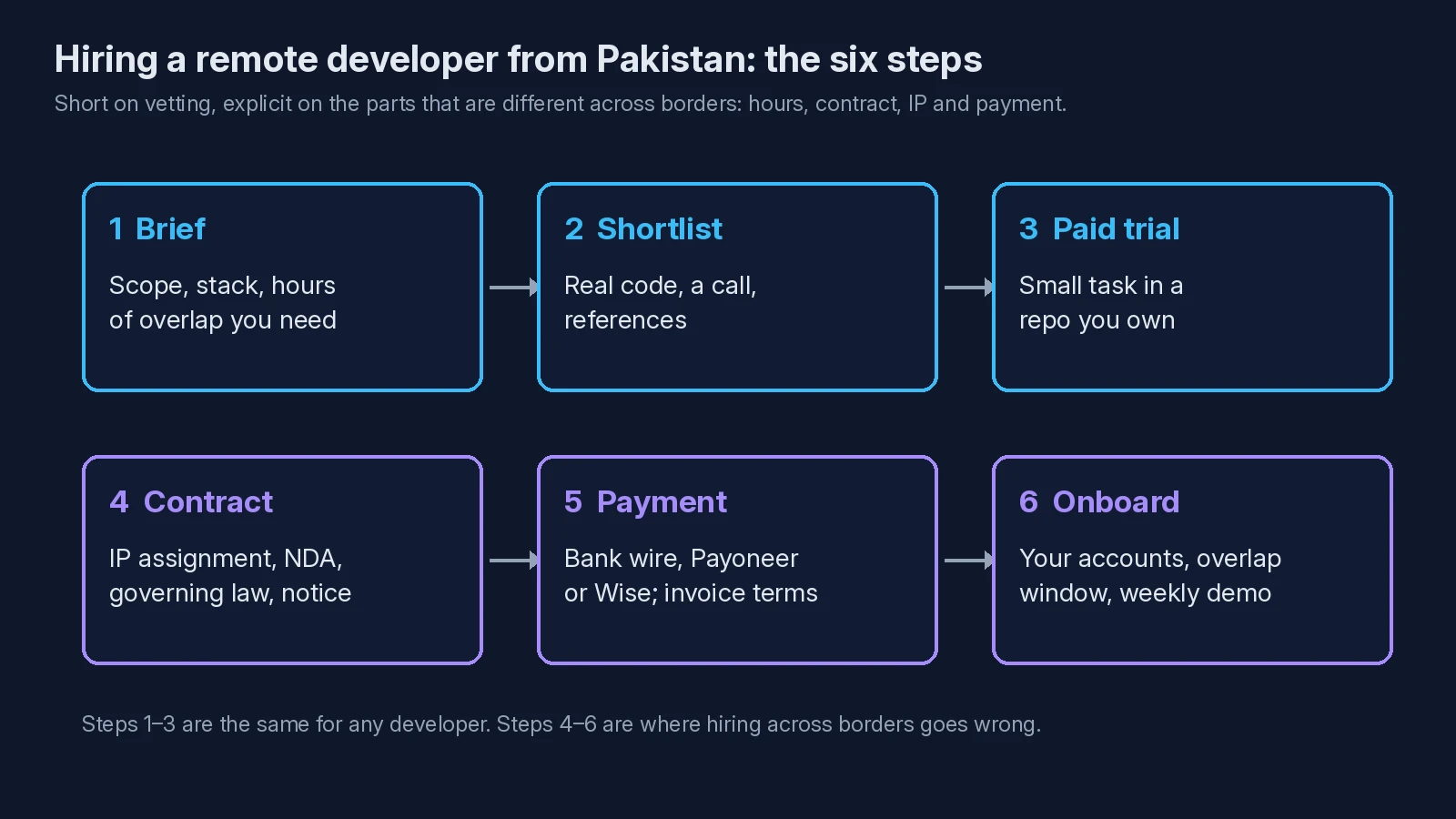
Figure 1. The six steps. The first three apply to any hire; the last three are where cross-border hiring needs extra care.
Time-zone overlap: plan the hours before you hire
Pakistan Standard Time is UTC+5 all year. Pakistan does not use daylight saving time, so the gap to your office changes twice a year if you are in the UK, Europe or North America.
Figure 2 shows the overlap between client office hours (09:00 to 17:00 local, standard time) and two common working patterns for a developer in Pakistan.
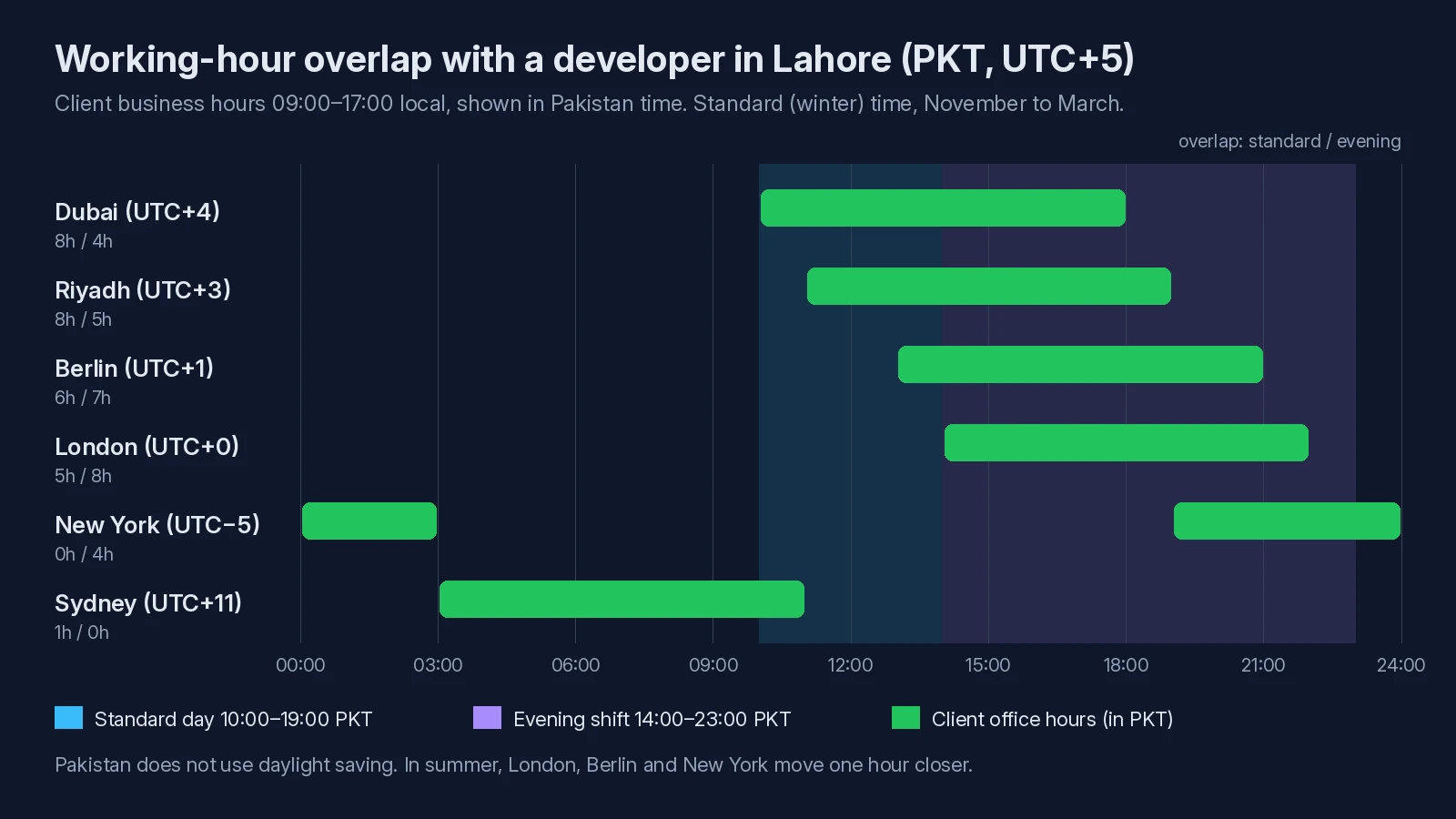
Figure 2. Working-hour overlap with Lahore (PKT, UTC+5) during standard (winter) time.
| Client location | Gap to Pakistan (winter) | Overlap with a 10:00 to 19:00 PKT day | Overlap with a 14:00 to 23:00 PKT shift |
|---|---|---|---|
| Dubai (UTC+4) | Pakistan 1 hour ahead | 8 hours | 4 hours |
| Riyadh (UTC+3) | Pakistan 2 hours ahead | 8 hours | 5 hours |
| Berlin (UTC+1) | Pakistan 4 hours ahead | 6 hours | 7 hours |
| London (UTC+0) | Pakistan 5 hours ahead | 5 hours | 8 hours |
| New York (UTC-5) | Pakistan 10 hours ahead | none | 4 hours |
| Sydney (UTC+11) | Pakistan 6 hours behind | 1 hour | none |
What this means in practice:
- Gulf clients get almost a full shared working day with no special arrangement.
- UK and European clients get a solid half-day of overlap on a normal Pakistani day, and close to a full day if the developer works a later shift. In summer, London and Berlin move an hour closer.
- US clients need to agree shifted hours up front. An evening shift in Pakistan gives you the US East Coast morning, which is enough for stand-ups, reviews and quick decisions. West Coast overlap is thinner, so plan around asynchronous work and one fixed call window.
- Australian clients get the Pakistani morning, which overlaps the Sydney afternoon.
Write the agreed overlap window into the contract or statement of work, for example "available 14:00 to 18:00 UK time on weekdays". That one line prevents most of the friction people blame on "time zones".
A few local calendar points are also worth knowing. The working week in Pakistan's tech sector is normally Monday to Friday. Eid holidays follow the lunar calendar, so their dates move every year; ask for them at the start of the year. Many people pause around midday on Fridays for prayers, and some keep shorter hours during Ramadan. None of this is a problem when it is in the shared calendar early.
Vetting: keep it short and look at real work
Vetting is not different because the developer is in Pakistan, so I will keep this section brief. The approach that works is the same everywhere:
- Read real code, not a list of technologies. Ask for a repository or a walkthrough of a feature they built.
- Hold one call where they explain a past decision, including what they would do differently.
- Pay for a small trial task, in a repository you own, that touches the parts of your product that matter.
I go into the details in two other posts. If your project is in Laravel, use my Laravel developer hiring checklist, which covers what to look for in their code and the red flags. If you are deciding whether one person can cover front end, back end and deploys, read what a full stack developer actually does.
One Pakistan-specific check: ask about their working setup. Power cuts (load-shedding) still happen in parts of the country, so experienced remote developers usually keep a UPS or backup power and a second internet connection. It is a fair, simple question, and a professional will have a clear answer.
Contracts and IP: the part you must get right
This is where cross-border hiring most often goes wrong, and it is not because anyone is acting in bad faith. It is because the default assumptions in your country may not apply to a contractor in another one. I am not a lawyer and this is not legal advice; have your own lawyer review the contract. These are the points to make sure it covers:
- IP assignment in writing. Do not rely on "work made for hire" style defaults. Use an explicit clause that assigns all rights in the code, designs and documentation to your business, on creation or on payment, as your lawyer prefers.
- Pre-existing code. Many developers reuse their own libraries or snippets. The contract should say that this code stays theirs, but you get a permanent licence to use it in your product.
- Open-source licences. Ask the developer to list third-party packages and their licences, so nothing incompatible ends up in a product you sell.
- Confidentiality. An NDA, or a confidentiality clause inside the main contract, covering your code, data and business information.
- Governing law and disputes. Pick the law and the venue, usually your own country, and say so.
- Personal data. If the developer will touch customer data from the EU or UK, your data protection obligations travel with that data. Pakistan does not have an EU adequacy decision, so ask your lawyer which safeguards (such as standard contractual clauses) you need, and give the developer access only to what the work requires.
- Notice period and handover. Agree how either side ends the engagement and what is handed over: code, credentials, documentation.
Most of the IP risk disappears with one habit: everything lives in accounts your business owns. Your GitHub or GitLab organisation, your hosting, your domain registrar, your payment gateway and your email provider. The developer is added as a user and removed when the work ends. If the code only exists on a developer's personal account, you do not own it in any practical sense, whatever the contract says.
Paying a developer in Pakistan
Payment is the other area where Pakistan differs from what many clients expect.
- PayPal is not an option for the developer. PayPal does not support accounts for Pakistani residents, so do not plan to pay that way.
- Bank transfer (SWIFT wire) to the developer's Pakistani bank account works and is common for larger monthly invoices. Expect intermediary bank fees and a few days for the money to arrive.
- Payoneer is widely used by Pakistani freelancers and companies. It provides receiving accounts in USD, GBP and EUR, and the developer withdraws to a Pakistani bank in PKR.
- Wise is useful from the client side. Pakistani residents cannot open Wise accounts themselves, but a client in a supported country can send money through Wise to a Pakistani bank account in PKR.
- Freelance marketplaces such as Upwork handle payment for you, at the cost of their fees and terms.
Whichever route you choose, agree on these points in writing:
- The currency of the invoice (USD, GBP or EUR is normal) and who pays transfer fees.
- Payment terms, such as monthly in arrears, or milestones for fixed-scope work.
- What the developer must put on the invoice for your accounting: legal name, address, bank or Payoneer details, and the period covered.
Tax treatment depends on your country and the developer's, so check with your accountant how to record a foreign contractor. The developer is responsible for their own taxes in Pakistan.
Onboarding: the first two weeks
A good start matters more than the hiring process. In the first two weeks:
- Create accounts in your organisation for code, tickets, chat and hosting. Use least-privilege access and turn on two-factor authentication everywhere.
- Confirm the overlap window and put a recurring call in it, even if it is only 15 minutes.
- Write down "done". A short definition covering code review, tests, staging deploy and your sign-off.
- Ship something small to production in week one. It proves the whole path, from repository to staging to live, works for both of you.
- Hold a weekly demo where the developer shows working software, not a status report.
FAQ
Is it safe to hire remote developers from Pakistan?
It is as safe as the process you use. Keep code and accounts in your organisation, sign a contract with a clear IP assignment, start with a paid trial, and pay against delivered work. Those steps protect you with any remote hire, in any country.
What time zone is Pakistan in?
Pakistan Standard Time (PKT) is UTC+5 all year, with no daylight saving. That is 5 hours ahead of London in winter and 4 in summer, and 10 hours ahead of New York in winter and 9 in summer.
How do I pay a developer in Pakistan?
The usual options are a SWIFT bank wire to a Pakistani bank, Payoneer, or a Wise transfer sent from your side to the developer's bank account in PKR. PayPal does not work for Pakistani recipients.
Can a web developer in Lahore work on US hours?
Many do. A shift from about 14:00 to 23:00 Pakistan time gives four hours of overlap with the US East Coast in winter. Agree the window before work starts and put it in the contract.
Work with me
I am a senior engineer in Lahore working with clients in the UK, Europe, the Gulf and North America on Laravel applications, APIs and WordPress builds. You can read about my background on the about page, see the full list of development services, or go straight to Laravel development if that is your stack. Send me your brief, and I will tell you honestly whether it fits one remote developer and how many hours of overlap the work needs.